

The evidence is clear: Staying in the market with quality businesses beats trying to time it.
Sounds simple but the execution is anything but easy. Only a tiny fraction of investors have the mental resolve to sit still. For the rest of us (myself included), it can feel psychologically impossible.
Does that mean we are destined for mediocre returns?
Not at all.
Instead of fighting our natural biases, we can learn to detect and regulate them.
While we might not achieve mathematically perfect outcomes, we can still do exceptionally well over the long run.
The Trick? Trimming and Buying Small
The secret to staying invested is satisfying the brain’s craving for action without sabotaging the portfolio.
When you feel the surge of greed or the chill of fear, don’t overhaul your strategy. Instead, trim or buy in small amounts.
These small trades satisfy your “monkey brain” and relieve its itch. But because the amounts are small, they won’t significantly impact your 30-year compounding journey.
Practicing What I Preach
I don’t just write about this; it’s a belief that underpins how I manage my work and my life.
As a former Physics teacher, I appreciate the theories that explain how our world works. However, those formulas often assume ‘ideal conditions’—where there is no friction or air resistance.
Real life is rarely frictionless, and the weight of our emotions creates a drag on our dynamics. There is no point insisting on a theoretical outcome if the experiment fails in practice.
It is thus far better to be 80% optimal and stay invested for 30 years than to strive for 100% perfection, crack under the pressure, and quit after two.
Here’s what I “succumbed” to in this quarter.
My Local Craving: Strengthening my Core Holdings
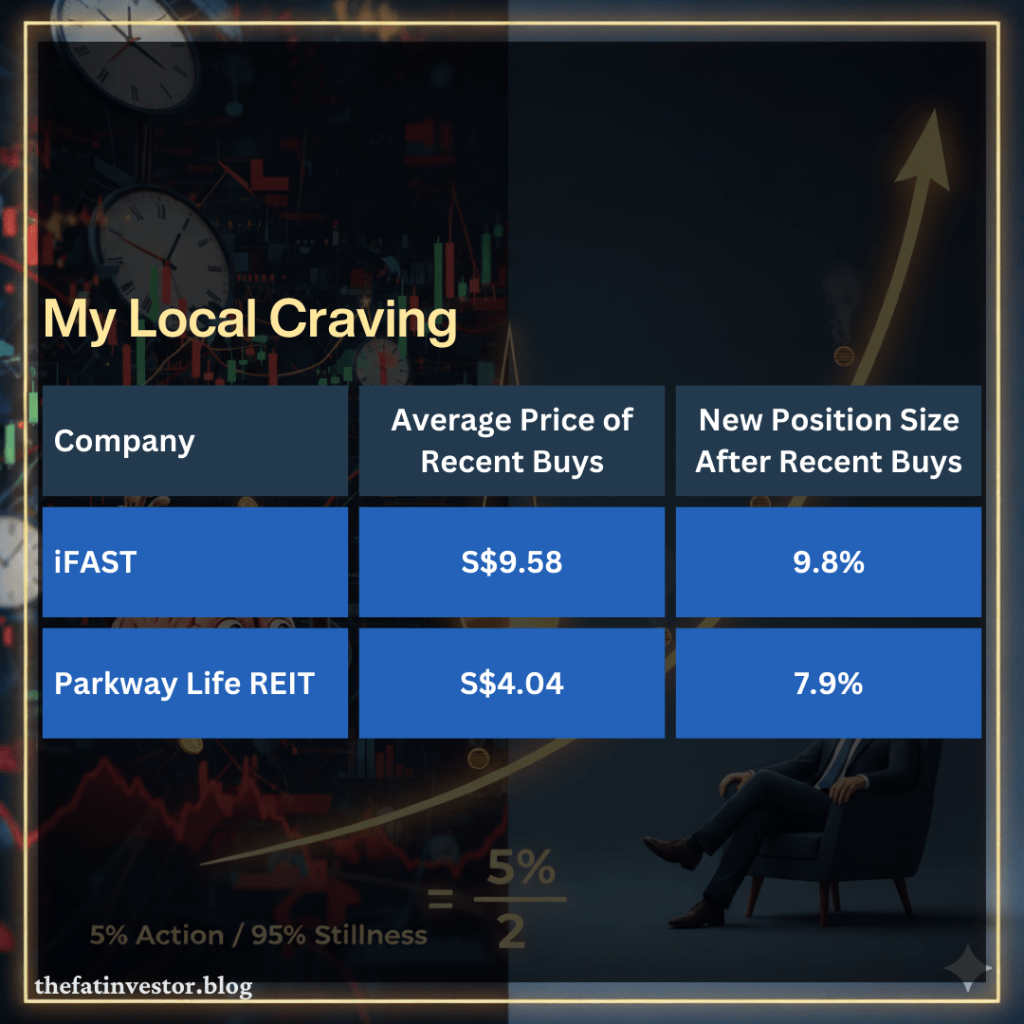
Before talking about my buys, let me briefly share why I trimmed UOB (U11) further in early February.
Following DBS’s (D05) latest results, the signal was clear: a 10% reduction in 4Q 2025 profits and cautious guidance suggested limited upside for Singapore Banks in the near term. Yet, oddly, UOB’s price continued to climb.
Intuitively, I chose to trim without rationalising it. As it turns out, that intuition was spot on.
UOB just announced its FY 2025 results this morning, with its 4Q 2025 profits dropping by 7% YOY and a reduction in its final dividend per share from S$0.92 to S$0.71.
More importantly, this spontaneous decision provided the capital for me to lean into screaming opportunities presented by two of my core holdings:
- iFAST (AIY): Despite superb results, the price plummeted by more than 10%. Whether CP Invest is still divesting or there are other technical reasons, my confidence in its medium-term outlook remains unshaken. It was an offer too good to miss.
- Parkway Life REIT (C2PU): After going XD, the price dipped below $4.10. At this level, I am confident in a potential 15% (or higher) total return over the coming year.
For a deeper dive on their results and outlook, you can read my previous posts (links at the end of the post).
My US Craving: The “SaaS-pocalypse” Sale
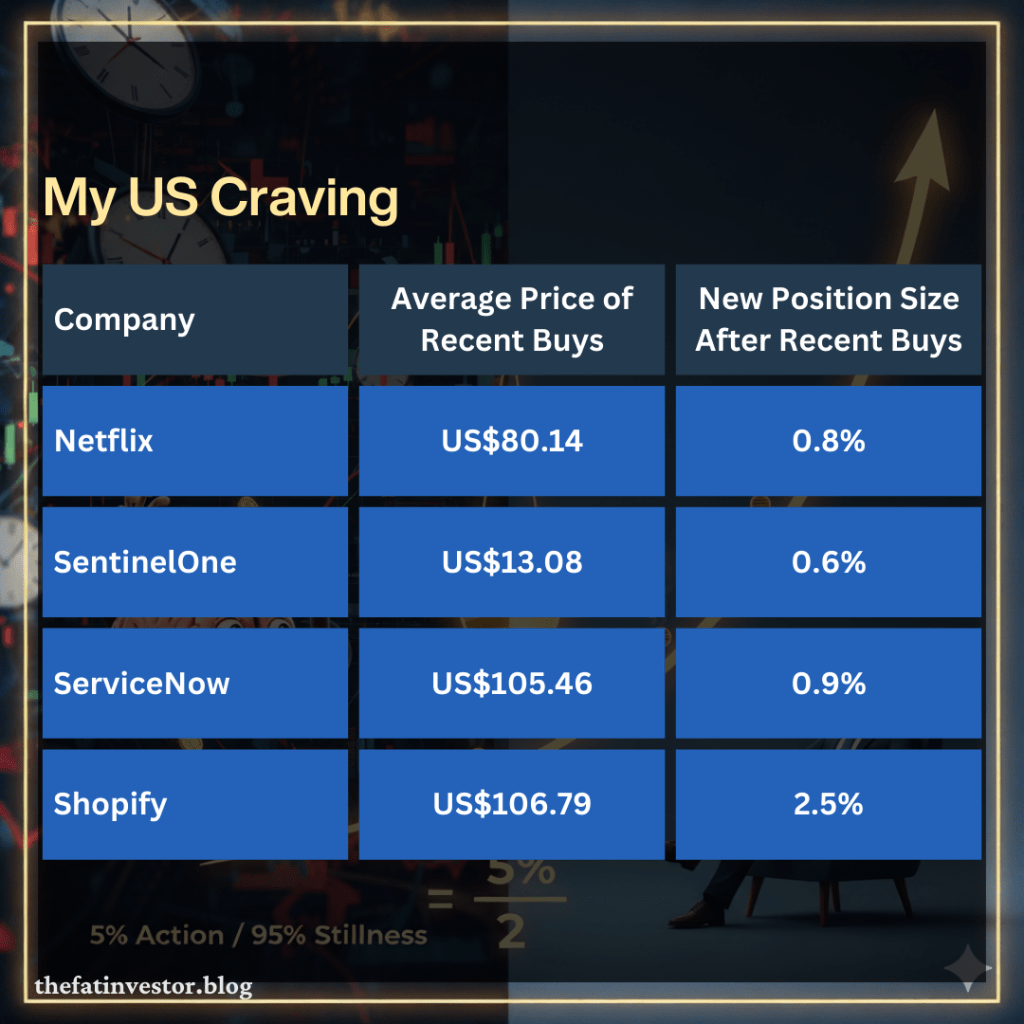
Now, for the Western cuisine.
The funding for my US buys didn’t come from a recent scramble; instead, it came from a similar trim I performed last October.
Since then, those funds have been parked in my FSMOne Autosweep account, earning interest while waiting for the right moment to strike.
The recent SaaS volatility was the perfect invitation to deploy that cash into businesses benefiting from the AI era:
- SentinelOne (S): Currently the cheapest cybersecurity play and, crucially, now profitable.
- ServiceNow (NOW): Usually expensive, it finally dropped to a price that is palatable.
- Shopify (SHOP): Unlike the “AI disruption” fear-mongering, I believe Shopify is a primary beneficiary of AI tools that make their merchants more successful.
Beyond SaaS, I also took advantage of the price drop in Netflix (NFLX). The uncertainty surrounding its recent acquisition news offered a great entry point to invest in its long-term future.
Again, for more details on these picks, refer to my previous posts.
No Impact, Ultimate Impact
As mentioned, the amounts involved in these trades are small — making up less than 5% of my total portfolio. Mathematically, whether these specific moves were “right” or “wrong” won’t significantly change my returns a decade from now.
There’s no impact.
However, by satisfying the “monkey brain” with that 5%, I’ve made it possible for the rational investor in me to stay the course with the other 95%.
That provides the ultimate impact on my long-term financial goals.
Related Posts
Beyond DPU Jump: Potential 15% Return for Parkway Life REIT in 2026?
iFAST Galloping into the Fire Horse Year. Price Doubling in 5 Years?
Portfolio Update: Dividend Rotation from Singapore Banks to S-REITs (and More)
Arista and Shopify: Unstoppable Momentum on a Long Runway
The Death of SaaS? Why I Added ServiceNow and SentinelOne in this CNY Sales
Will Netflix Be the Next Hit of My Portfolio? Why I Jumped In @US$85
Why I Trimmed the US Portfolio: Emotionally Logical
Disclaimer
This content is for informational only. I am not a financial advisor, tax professional, or legal expert, and the information shared here does not constitute personalised financial advice, nor is it a solicitation to buy or sell any securities or financial instruments.
All opinions and commentary reflect my personal views and are based on general market commentary.
You are solely responsible for your own financial decisions. Investing involves risk, and any action you take based on the information provided on this blog or channel is strictly at your own risk.
Always conduct your own research and due diligence and consult with a qualified, licensed financial professional, tax professional, or legal advisor before making any investment or financial decision.
Discover more from The Fat Investor
Subscribe to get the latest posts sent to your email.
 The Fat Investor